Guide to Training Cup Styles
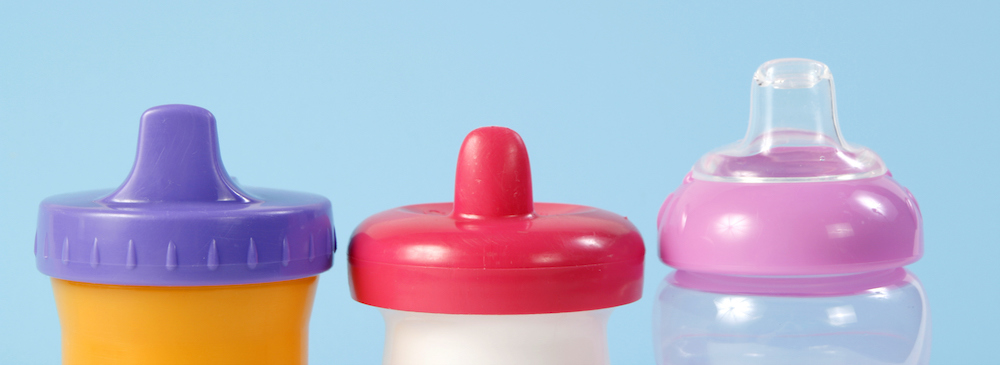
There are a wide variety of cup styles available. Below is a guide to the different types of cups you may find in your search. Learning about the qualities of different cups will help you choose one that will work best for your baby.
With each style of cup, you will find those with and without handles. Handled cups are a great way to start your baby on a cup. They make it easier for her to hold. It will also give her the freedom to control the cup. Once she starts becoming comfortable with a cup and its handles, you can move on to a cup without handles. With each phase of learning to use a cup, your baby will become a little more independent.
(Photos below are in no specific order)

Open Cups
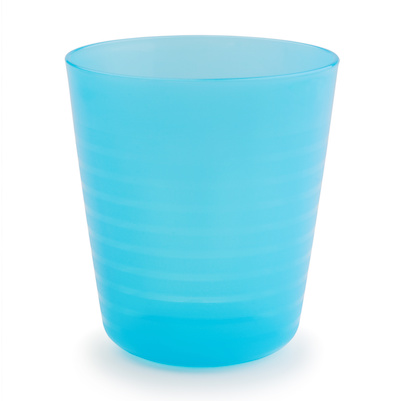
An open cup is just that, completely open. The liquid will go straight into the child’s mouth when tipped.
PROS:
There is no adjustment to another cup, as an open cup is the end goal.
There is no need to buy special cups if baby goes straight to an open cup.
CONS:
Spills are a great risk as there is no lid if the cup gets tipped over.
Because there is no funnel or spout, too much liquid may pour into the baby's mouth if tipped too much.
Free-Flow Spout Cups
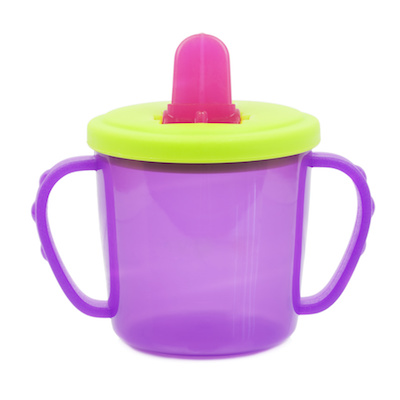
The free-flow cup pours its liquid straight into your child’s mouth when tipped.
PROS:
Babies’ mouths form different shapes around a free-flow cup. This exercises facial muscles differently than other cups.
Like with an open cup, liquid is more likely to go straight to the back of the mouth with a free-flow spout. This helps to prevent liquid from pooling around the teeth, putting your baby at a lower risk of tooth decay.
Free-flow cups more closely resemble drinking from an open cup. This means that when your baby is ready to use an open cup, she will have less of a transition.
CONS:
Free-flow cups spill when tipped over. However, you can find cups with flip-up spouts to avoid leaking.
Liquids can pour too quickly from a free-flow spout for some babies.
Cups with Soft Spouts
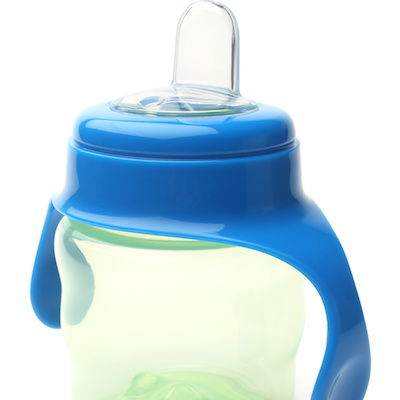
Soft spout cups come in valved and free-flow varieties. Soft spouts can be used as early as 4 months of age. When getting this kind of cup, look for one with replaceable spouts. This will be cheaper than buying a new cup.
PROS :
The transition to a cup with a soft spout may be easier for babies used to a bottle or breast.
They are helpful for teething babies.
CON:
Soft spouts are generally easier for your baby to chew holes in.
Cups with a Straw
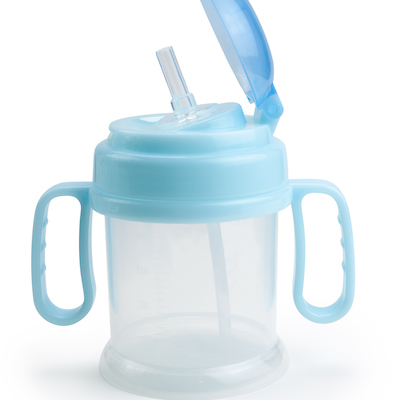
You can find baby cups sold with a lid and straw. Another option is to place a straw in an open cup. Using a cup with a straw is best for babies starting at 12 months.
PRO:
A cup with a straw requires your baby to do a pursing motion with her lips. This exercises more muscles in her mouth than a cup without a straw.
CON:
A straw may be harder for your baby to use when first introducing her to a cup.
Cups with a Valve
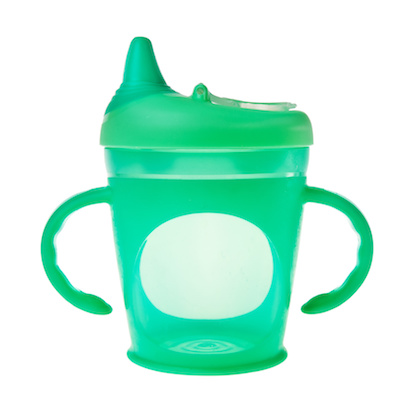
The valved spout opens when your child sucks. This provides a constant stream of liquid until she stops sucking. Then the valve will close.
PROS:
The sucking motion of a valve cup resembles that of a bottle or breast, making it more familiar for her.
Valved spouts are non-spill.
CONS:
The American Dental Association does not recommend using training cups with valves. The goal when transitioning to a cup is to shift your baby from sucking to sipping. The sucking motion that training cups with valves require is similar to that of a bottle. This makes the transition to an open cup slower than the transition from a training cup with a free-flow spout.
The take-apart and put-back-together process of a cup with a valved spout is more complicated than one without a valve.
Mold can easily build up in the valves.
Open-Faced Cups
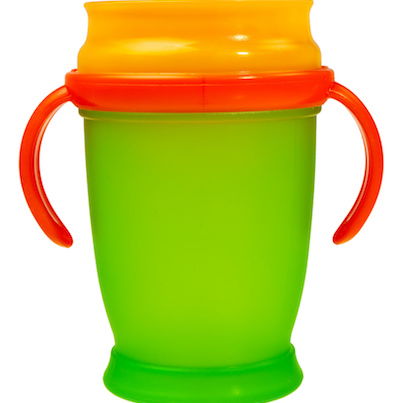
Open cups are the end goal when transitioning from a bottle. Some moms decide to go straight to a cup from breastfeeding to avoid nipple confusion. Other moms go from bottle to open cup. It is all in what works best for you and your baby. There are many cups made just for this phase in your baby's development. Some come with weighted bottoms. This makes it easier for her to start to balance the cup and avoid spilling. Others have a valve around the opening. This helps to reduce spills as well. If using a training cup, another option is to remove the lid from a training cup she is already used to, to make it an open cup.
PROS:
Open-faced cups help with hand-eye coordination.
Using an open cup does not require purchasing any special training cups.
CON:
Open-cup drinking can be a messy process that requires a lot of patience.